Manual · 8
The knowledge base
The documentation you would keep open in another window is inside VCSIDE. Press F1 on any word and its page opens in the Documentation panel.
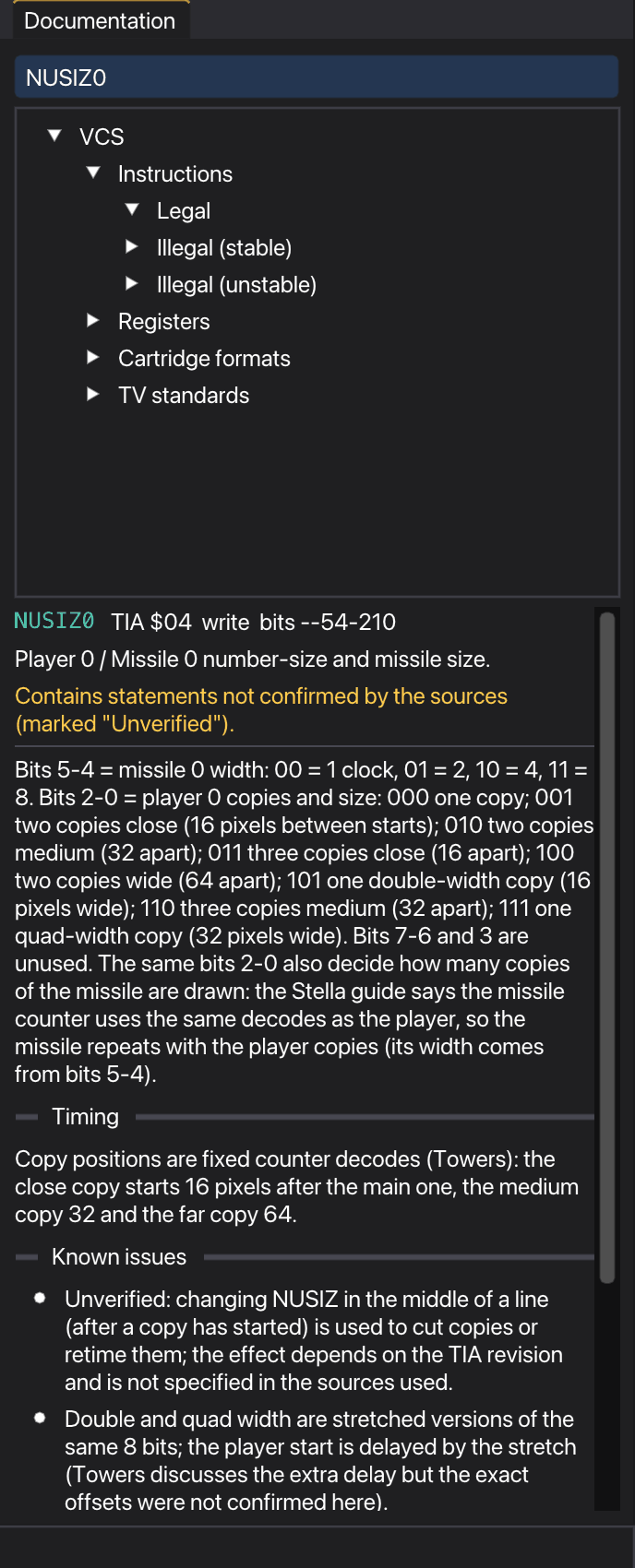
NUSIZ0: address, bits, timing and known issues.What it covers
The 6502
All 256 opcodes, grouped as legal, stable illegal and unstable illegal. Each one has its addressing modes, bytes, cycles (with the extra cycle when a page is crossed or a branch is taken), the flags it changes and what it does. The same data gives the editor its cycle column and its hover help.
The TIA and the RIOT
Every register of the two chips, with its address, whether it is read or written, its bits and what they do, its timing (such as RESP0 taking effect on a given colour clock) and its known issues: HMOVE on cycle 73, RESBL during horizontal blank, collisions, differences between TIA revisions.
Cartridge formats
2K, 4K, F8, F6, F4, FE, E0, E7, 3F, 3E, FA, DPC, DPC+, CDFJ and ELF, with their size, bank-switching hotspots, extra RAM, how emulators detect them and the name Stella and Gopher2600 expect.
TV standards
NTSC, PAL, PAL60 and SECAM: lines, frame rate, palette and advice on each.
Finding things
The panel has a tree of everything it knows and a search box. Its root, VCS, goes back to the general notes on the Atari 2600. F1 on an instruction, register, format or batari Basic keyword in the editor opens its page, and hover help shows a summary without leaving the code.
Sources
The knowledge base was written for VCSIDE, in its own words. Every fact in it lists where it comes from: the Stella Programmer's Guide, the MOS 6532 datasheet, Andrew Towers' TIA hardware notes, documents on the 6502's illegal opcodes, Kevin Horton's notes on cartridge formats, and the source code of Stella and Gopher2600, checked by assembling and running test ROMs. Facts that couldn't be confirmed are marked as such.
The knowledge base is CC BY-SA 4.0: you can reuse it in your own tools and documents, giving credit and sharing alike. The full list of sources is in VCSIDE's About window.